

juxtaposition.
a manifesto on writing.

I have been wanting, for some time, to write a manifesto on writing.
This is not because I think I have a unique perspective on craft, nor because I have thoughts on something I have read about writing. My shelf does not hold a copy of King’s On Writing or Orwell’s Why I Write because I tend to be rather unmoved – for better or worse – by writers writing about their writing processes.
But, I do understand their impulse. It must be a sort of tradition for famous (and less famous) writers to write consciously of their craft, their use of their chosen language, and generally what moves them. I wonder then, if it is a relevant aspect of “becoming a writer” or perhaps even, “being a writer”, writing a manifesto, a personal guide on a personal style. Maybe my only reason for writing these words now then: it just feels correct; it just seems right.
Regardless, I am compelled, almost pathologically, by the demands of the craft. I think about the relationship between words daily. I have a strong sense of their proper order. Often this makes me a pedant and a nuisance but occasionally it allows me to craft passable work. In other words, I have a series of beliefs about writing that I apply in my work. They are strong within me; and so, a manifesto must be written.
We begin simply with a watch-word: juxtaposition. If there is, in my opinion, one necessary component of storytelling, of writing, of argumentative craft, of artistic expression writ large, it is contrast, distinction, difference: in a word, juxtaposition.
This is, at a certain level, an entirely expected assessment – and perhaps one that already signals the pedantry of this essay. Yet, it is only in pedantry that we may become acutely, almost painfully, aware of the way that our art does its work. So, allow me to carefully explore the role of juxtaposition through a a range of mediums, a philosophical traditions, several brutally simple clauses, before finally reaching the written word and engaging carefully with fiction and the role of juxtaposition therein.
Juxtaposition is a well-established and fundamental aspect of film. Many are familiar with the Kuleshov effect, the idea that more meaning is created in the relationship between two shots than through the individual shots themselves. In other words, it is only in the contrast between the two individual pictures that a film can mean something at all.
Consider one of the most famous scenes ever put to celluloid: first, a shot of Luke Skywalker looking outward, second, a shot of the twin suns. The first and obvious meaning is the second shot is what Luke sees, the suns are the object of his view, that Luke looks at the barren landscape of Tatooine and the twin suns hanging above. The second meaning created is that of the threshold: Luke stands on the precipice of journey, looking out upon the space that he has to choose to venture into. It is only in the juxtaposition of these two shots that we are able ascertain that more thematically layered understanding of the scene.1
Consider too: the joke. A joke works, most often, by subverting an expectation, by juxtaposing the set up and the punchline. A comedian will move through a story that feels familiar and then, at the very end, twist the premise upon its head. I think this idea should be quite intuitive to anyone who has spent anytime watching stand-up comedy, but should become entirely apparent after watching Stewart Lee’s set on political correctness. The twist of each bit is always a juxtaposition – often heightened in some way – and always runs counter to the expected. The punchline – “basically, there’s a whole generation of people that have confused political correctness with health and safety legislation” – works so well because of the obvious juxtaposition of two seemingly disparate ideas.
Finally, consider painting. This is perhaps the most pedantic consideration of this manifesto, but it is worth at least passing thought on the way to more interesting considerations. A painting only “works” – creates an effect in the viewer – if it manages to frame some contrast.
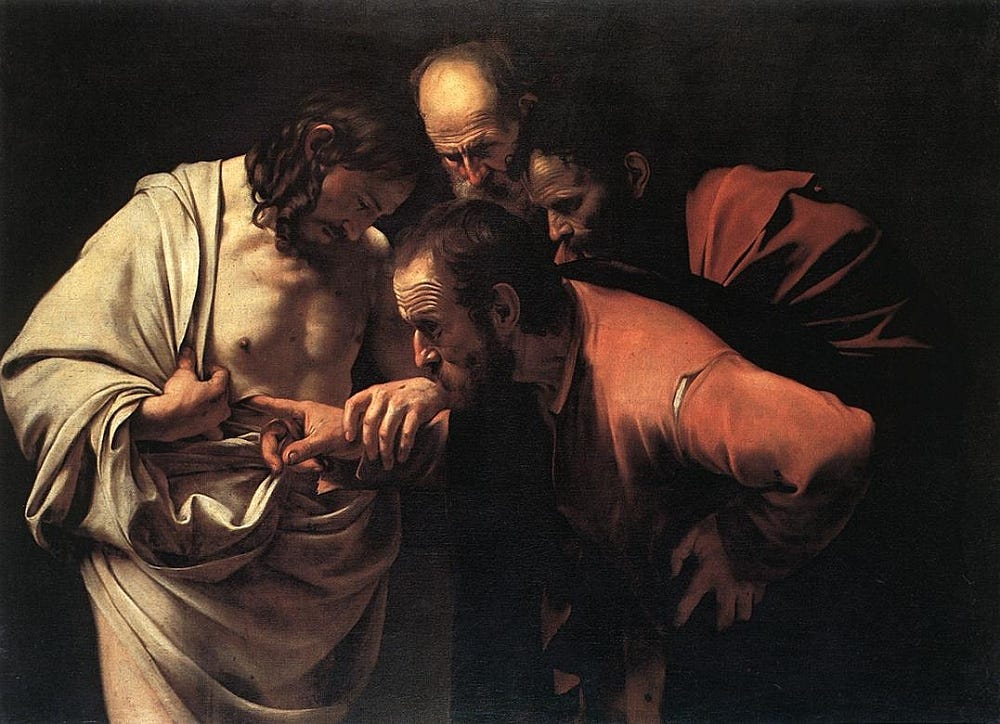
Caravaggio comes to mind: it is in the extreme and dramatic difference between light and dark that a particular focal point becomes readily apparent. In other words, the darkness offers itself against the light – and thus the evocative emotion of the scene becomes apparent. This can be reduced to an admittedly absurd degree: for even the most basic artistic representations, there must be a contrast between the canvas and what the canvas holds. A brush stroke, an ink blot, the motion of a pencil, must juxtapose with the space chosen for its placement.
Of course, the obvious truth that painting requires degrees of contrasts – pace Rothko – leads us to perhaps more philosophically fundamental territory. That there is a difference between something and nothing, that there is a divide between the self and other, the self and the world (the Real), that there is even a divide within the self, that the self is divided… it is only through these distinctions that meaning seems to arise. Difference, juxtaposition, is the vector, in other words, along which understanding may function. A world without difference is a blank canvas.
At risk of diving headlong into my philosophical inspirations Jacques Derrida, we might all-too bluntly explore his work on difference – and perhaps more specifically, différance. When we looked closely at language – as Saussure, one of Derrida’s progenitors, does in his work – we will note that a word, a sign, can be understood as a “signifier” of the thing it to signifies, the “signified” object. When I write the word “tree” I am merely offering a signifying mark; the tree is not, in the moment of my writing, here. This is why meaning is deferred. A word creates meaning by being at a distance from the thing that it means. A word, to be very technical, is a present absence, or an absence made present. The tree appears here in these words, even as its body is absent. Meaning arrives in the difference between words and their associated objects.
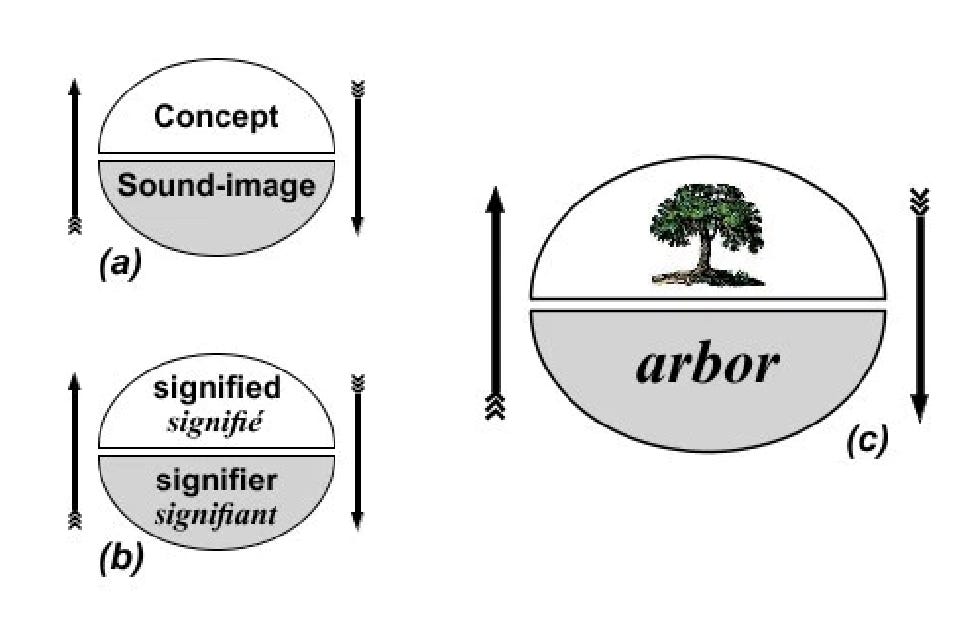
The issue here is of course that the connection between a word and its meaning is, when we look closely, quite tenuous. Following from Saussure again, Derrida goes so far as to say that the relationship is entirely arbitrary. Indeed, that we call the plant made of wood a “tree” is entirely arbitrary; and indeed, the word-sound “tree” does not actually get us closer to the object, the Real of the tree, but rather positions the object within our lexicon, within a “play of differences”. Much of Derrida’s project reveals that it is only in the “play” of absence and presence between and within signs, that meaning can exist.
This can be made somewhat more clear by another pedantic comment: the only way that I can describe to you “tree” is with reference to other, different signs. A tree is a plant that grows tall and strong; a tree has bark; an example of a tree is a pine. None of these specific sentences communicate exactly what a tree is, but they approach a meaning, through language. Importantly, the presence of a specific tree – or the hypothetical Platonic Form of a tree – can never arrive through language. As such, signs always defer their meaning – to the next word, to an absent thing, to a transcendental authority that might offer organization. Yet, that deferred meaning will never arrive; I can never find the ideal way of describing a tree within a linguistic system.
While it is difficult to summarize Derrida, and Derrida scholars often chafe at the need to simplify his incredibly esoteric ideas, we can conclude the following from much of his early work: différance is a motion or force that both allows for linguistic meaning to take shape within the realm of knowledge (to take on ontological consistency) even as it fundamentally resists any final arrival of an ideal meaning. In fact, if that final arrival were theoretically possible, there would be no reason to continue writing or reading or interpreting the world. We would already be complete.
It is important to note to additional things about Derrida’s work: first, différance exists “before” language as we use it colloquially exists, though it is impossible to even comprehend its origin; its a bit like trying to imagine what “existed” before the Big Bang, as “existance” as we currently understand is so confined to the realm of our current metaphysical structures; as such, and this is our second point, différance troubles and disrupts metaphysical certainty, meaning that for Derrida, being is no longer a certainty that we can take for granted. This is why many people find Derrida and his disciples so frustrating; he seemingly refuses our capacity to know anything at all. How he moves through this seemingly fundamental contradiction is a story for another day.2
This is all a little heady. Is it necessary, you might be asking? An essay about writing has poked into the very origin of language and its capacity for meaning. Certainly as an artistic endeavor, as a personal project, as a hobby, as even a mere pass time, writing need not become philosophy in order to do its work….
At a certain level, I think it does. A good writer will always approach the forces that it sets their writing to work. In fact, I believe that the only reason to write is the contemplation of the force behind language – and particularly, the linguistic force of difference. In writing, one is always splitting, shearing, dividing, corralling, containing. In writing, one is constantly making decisions and incisions. And it is through this difference-making (for lack of a better term) that an author crafts meanings – and particularly new meanings. Derrida, from my vantage, offers us a very philosophically interesting approach to those forces, but our work does not need to become an exercise in deconstruction. All that we need is a way of conceptualizing writing as a product of difference.
We can return to the stylistic realm. Consider the following sentence:
The sun shines.
What do we have here? A grammatically correct independent clause – and thus a sentence. We might note too that the meaning of the sentence arrives to us in the relationship between the words – “the sun” and “shines” on their own do not communicate as much meaning as they do together. We can then follow from Derrida: the sun, a signifier for the great ball of gas in the heavens, does not communicate its own meaning; it only exists in a deferred relationship to other signs. In other words, “sun” only exists in a chain of signification, further words and ideas that clarify the signifiers place – like, light, day, morning, dawn…. Of course, with the addition of “shine”, much more meaning is produced. Most simply, it is active; but perhaps too, it is emotive, and opens onto much more complex meaning. The sky is clear; perhaps it is a nice day; it is warm or beautiful… etc.
Consider another sentence:
The sun burns the cold earth.
Now we have a more interesting sentence – subject, verb, direct object! – and a more obvious juxtaposition. The sun on the one hand, the cold earth on the other. We can start to feel the difference in the heart of the sentence now; we can feel the heat of the sun better because of the contrast. Again to think along side Derrida, because meaning is deferred and because it is only through chains of signs that we can build meaning, to create specific meanings, we want to lay some claim to a specific sort of difference; in other words, writing often works between when it pulls the reader through a specific division.
We might see this best with this last example:
The sun lashes the cold earth.
Now we have a compelling degree of complexity. Lashes defers a whole host of new meanings – an attack, perhaps the unjust attack with a whip, or at least some quick violent motion that slashes or cuts, or perhaps too wind on an open sea… etc. – but the specificity of the relationship between the subject and object gives us both a very specific meaning, and a compelling set of possible interpretations. It is evocative because it constrains the readers attention so that the meaning of the phrase is given a specific direction.3
Now, writing does not only do its work between words; it also functions between sentences, between paragraphs, between chapters. As we might expect, juxtaposition does as well. Lets then look beyond the formation of interesting sentences, and towards the formation of interesting themes and ideas within works of literature.
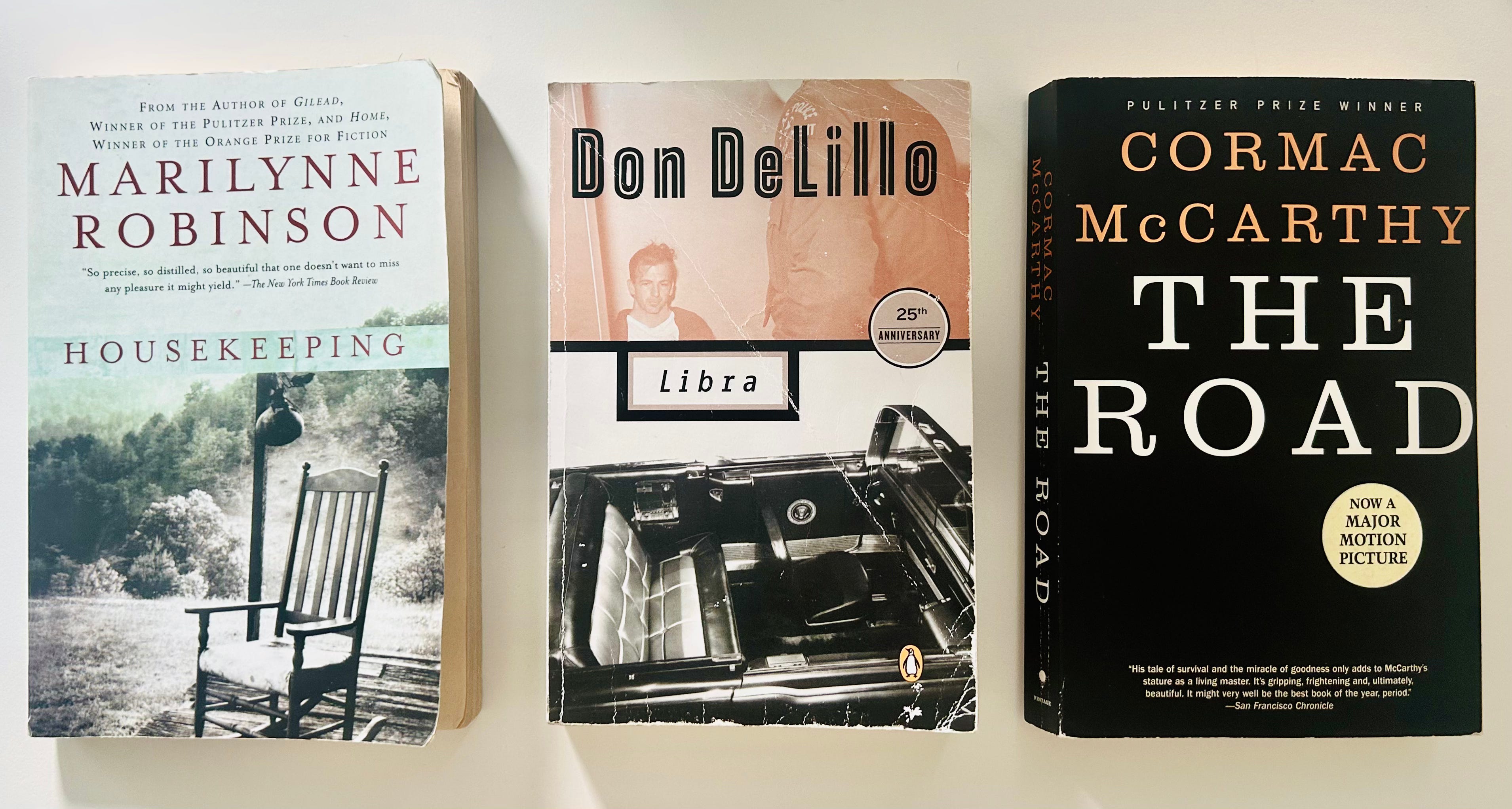
Marilynne Robinson’s Housekeeping is one of my favorite novels to read when considering prose-craft. A quick summary for those who have not read it (though you should, it is beautiful and excellent): two sisters are left orphaned after their father perishes in a horrific accident and their mother commits suicide. After spending sometime with their grandmother, their aunt arrives to town and takes to keeping the sisters and the house in which they were born. Their aunt, Sylvie, is an odd force in their life, at once compassionate and aloof. Soon after her arrival, there are great rains that flood the first floor of their house.
In the days following the flood, the frozen lake near the town collects the run-off rainwater. The combined weight break the frozen surface and begins to move the large heaps of ice. Thus, the following passage:
‘It’s a shame,’ Sylvie said. From the lake came the increasingly terrific sound of wrenching and ramming and slamming and upending, as a south-flowing current heaped huge shards of ice against the north side of the bridge. Sylvie pushed at the water with the side of her foot. A ribbed circle spread to the four walls and the curves of its four sides rebounded, interpenetrating, and the orderly ranks of light swept and swung about the room. (64)
Beyond the pure beauty of the passage, there is, at the center of this simple moment, a juxtaposition: Sylvie prodding the water and the weight of the flood collapsing the winter freeze. How much meaning is created here? An impossible quantity. The clear implication is that Sylvie is a force in herself – perhaps not one as powerful as that of nature, but one that certainly prods at the world in which she exists. Indeed, our narrator apparently sees Sylvie in the same way, in the same breath, that she sees the surrounding chaotic environs. In a way, we might even see Sylvie as bigger than her new home; with a small push she able to cast a great many reflections about. And we might go on.
Another example: Don Delillo’s Libra – the fabulist’s rendition of the life and times of Lee Harvey Oswald. Early in the story, as Dellilo establishes the character and childhood of the “lone gunman”, we get this sequence of paragraphs:
He did Human Figure Drawings, which were judged impoverished.
The psychologist found him to be in the upper range of Bright Normal Intelligence.
The social worker wrote, “Questioning elicited the information that he feels almost as if there is a veil between him and other people through which they cannot reach him, but he prefers this veil to remain intact.”
The schoolteacher reported that he sailed paper planes around the room. (11-12)
Between these individual ideas, we are given a picture of a young Oswald that is entirely defined by others’ judgment of him. A tension becomes apparent: people around Oswald perceive a difference within him, yet it is one that does not make itself entirely clear in his actual existence. He is normally intelligent; is not the best at drawing; he is inattentive in class; yet, something is still off. In contrasting different people’s perspectives of the boy, we find a melancholia that only arrives because these passages follow each other, in the listing, in the banality of their being juxtaposed. Further too, it becomes apparent that attempts to describe Oswald might actually be driving him further away; he is a man over-signified by those around him, a hyper-visible individual, so it becomes clear why he feels that he must remain veiled and hidden. This is of course, a major theme of the text: Delillo’s project is inherently impossible, for he will never be able to tell the complete story of an inherently mythical figure at the center of an entirely mystical conspiracy.
One final example, and perhaps my favorite: the final paragraph of McCarthy’s The Road.
After this grave humanist tale, after this great attempt to find, within the soul of man, some reason to continue to live and love and protect, after the death of our protagonist and the strange adoption of the boy by characters barely introduced into the plot, after the subtle and beautiful and tragic affirmation of the “breath of God”… the novel ends with the following:
Once there were brook trout in the streams in the mountains. You could see them standing in the amber current where the white edges of their fins wimpled softly in the flow. They smelled of moss in your hand. Polished and muscular and torsional. On their backs were vermiculate patterns that were maps of the world in its becoming. Maps and mazes. Of a thing which could not be put back. Not be made right again. In the deep glens where they lived all things were older than man and they hummed of mystery. (287)
Forgive me if you have not read The Road, for this passage, as it appears juxtaposed to the quiet and tragic climax of the story, is perhaps one of the most moving pieces of writing I have ever experienced. I have certainly ruined it by wresting it from its proper place. But I must share it, for it represents the value of juxtaposition at a nearly theological extreme.
In one fluid motion, McCarthy takes us from a quiet affirmation of belief and human dignity despite great suffering and blasts us beyond the human and into the great mystery of the universe. By juxtaposition, McCarthy entirely recontextualizes the entire trajectory of the story, places it within an eternal maze, imprinted on the backs of animals and within the water and upon the mountains. Meaning explodes from this passage, gives to our understanding of the “breath of God” a whole new texture, one that we cannot leave within our human characters and their desiccated world. At its most extreme, juxtaposition should preform this exact task: it should explode.
To summarize, the central premise of this writing manifesto is simple: it is only in juxtaposition and difference that one can make meaning. In so many ways, I feel that I have shown this convincingly. Even if we place the philosophical considerations to the side, surely my many examples reveal the relationship between juxtaposition and meaning within art broadly.
But the obvious question – following from our relatively simple premise: what does juxtaposition do? or, as I have frequently phrased it, what is the work of juxtaposition?
This is perhaps the philosophical heart of the discussion. There is, to be needlessly philosophical once again, a difference between the descriptive reality that meaning is always (or at least most often) created through difference, and the normative implications of this reality. I will offer here some brief normative considerations.
Perhaps most simply: if we want to understand our writing, we need to understand how juxtapositions are going to make meaning – and thus affect our readers. It is this attention – and ultimately, this intention – that can help us shape our work to create specific meanings consciously, rather than letting the signifying chains that we subconsciously operate upon dominate our view. This of course leads us to another obvious argument: good writing, lasting writing, writing that means something specific and different, is writing that endeavors to create new meanings. If juxtapositions make meaning, we need new juxtapositions to create new meaning.
But why is novelty good? At a very reductive level, new difference or contrasts are interesting. It is nice to see and read new things. More specifically though, novelty as an aspiration is relevant to changing the way that our collective understanding functions. New juxtapositions create new meanings; new meanings shape new perspectives.
This should bring home an abundantly obvious point: our reader is an incredibly important facet of this discussion. New differences reshape readers; a strange phrase holds a mirror to an individual. This is, again, obvious to anyone who loves writing, but it is an important point to place into the context of this manifesto: juxtapositions are a readily effective way to do this. Creating a strong contrast (see McCarthy again), dealing with a specific difference, phrasing something in a way the unsettles a previously uses word or phrase… this is how we shift perspectives and ultimately, how we help our readers grow into more developed, interesting, and thoughtful people.4
Finally, to take a political tact, we might begin to see why difference – sexual, racial, cultural, artistic, philosophical, etc. – is such a danger to ethnocentric projects; it should also show us why opposition to difference is the fascist method. Any totalizing political movement cannot abide difference, certainly any juxtaposition between the self and the other; they hammer the world into a shape of their choosing, an apparently whole meaning. However, an artistic attention to difference, to juxtaposition, reveals the fraudulent nature of that self-same shape. Novelty in writing, a progressive attitude towards meaning-making is a subversive element, a way of revealing the tenuousness and complexity of our shared spheres of meaning.
Surely we could say more of intrigue and taste; we might explore the use of juxtaposition in crafting persuasive essays; we might also further elucidate subversive art. Yet perhaps, this is where we move beyond our initial scope. Suffice it to say, for now, that you ought pay heed to the contrasts that you create with your words, and I am certain that your writing will blossom forth stronger.
Thanks for reading. I was very conscious of how pedantic certain aspects of the piece are, and so I appreciate you sticking around to the end. If you liked this, please consider subscribing. It makes me very very happy.
If you are interested in an extended discussion on this topic, please let me know in the comments; I would be more than happy flesh out some of these arguments further. I have been wanting to write more about Derrida, as I think he is an interesting thinker to work with, but I don’t quite know what the audience for such writing looks like so I have been a little bit hesitant to start; if you would like to see more about the French deconstructor himself, please say so and I will dive into his expansive work.
Otherwise, have a great weekend,
Thanks as always,
zach
We can imagine, as a sort of counterfactual, this same sequence filmed in a single take, in which the camera swings from Luke’s contemplative face onto the surface of Tatooine only to stop and linger upon the twin suns. Would this shot create the same of meaning? It is hard to say for certain – but, it would certainly create a different meaning, for the single shot structures the contrast between Luke and the prospect of his journey differently. It is certainly safe to say that a hypothetical single shot might lessen, by a degree or two, the clear distinction between the world Luke knows and the world that he must decide to enter.
Much of this explanation comes from my understanding of Derrida’s essay “Différance” which is, in a certain way, one of the better places to start with Derrida. Much of Derrida’s work I find quite interesting and useful, even if many find him far too esoteric. To offer my most simple defense of the man, as a long suffering reader of his, I would say that his work helps us understand the limitations of language as meaning. He cautions us at too quickly ascribing authority over certain utterances, and gives us a series of tools for engaging more critically with language as a historical and cultural force. He is certainly not the only place to find such tools, and I would not say he is a necessary philosopher with which to engage; but he is surely a compelling read; if you are interesting, he is worth your time.
As an aside, this is why Derrida’s deconstruction is not a destructive process; he does not want us to tear through texts and their meaning. In recognizing the fallibility of our linguistic systems, we can find new ways of creating meaning. In an almost existentialist way, recognizing the failure of language opens onto a whole host of new and interesting possibilities.
This is why I consider poor education in the humanities a form of violence: the inability to confidently read and write – and indeed the lack of desire to read and write, a desire that I believe can easily be taught – limits children’s ability to understand the world that they inhabit and the linguistic systems that they use regularly. This is perhaps the great tragedy of our age.
This was awesome! Derrida is one of those guys I wish knew more about. I’m a sucker for any and all forms of language philosophy.
You mention it briefly, but I think it’s one of the most overlooked facts about writing: the fact that meaning exists in the between place is what makes poetry literally possible. Your examples about the sun shining illustrate this wonderfully.
Thanks for this — subscribed.
This was so wonderful to read. Your mix of pop culture, high lit, and Derrida for dummies worked perfectly to convey the point you made about juxtaposition and its centrality in art and politics. I feel like Wittgenstein’s concept of language-games could deepen this discussion in a veeeery interesting way. Great work!